
Our Services
Psychology explores how environments influence the way people think, feel, and behave. Spatial design has the power to shape emotional response, guide movement, and affect how individuals interact with information and with each other.

Our approach places human experience at the centre of the design process.
By understanding behavioural patterns, cognitive load, spatial perception, and emotional comfort, environments can be designed to support meaningful engagement. Elements such as spatial scale, lighting conditions, circulation patterns, and visual cues are carefully orchestrated to make environments intuitive and welcoming.
Through research, observation, and user insight, we study how people interact with space and translate these findings into design strategies that enhance learning, collaboration, and wellbeing.
Across every project, the objective is to create environments that respond naturally to human needs, ensuring that people feel comfortable, oriented, and inspired as they move through the space.
01
Understanding user groups, behaviours, and expectations to shape environments around real human needs.
02
Mapping movement patterns and interaction points to guide how people navigate and experience the space.
03
Designing spatial elements that support intuitive interaction, comfort, and meaningful engagement.
04
Realising the environment with careful attention to how people move, interact, and respond within the space.
01
Every human-centred environment begins with understanding the people who will use it.
We examine user groups, behavioural patterns, and expectations to identify how individuals interact with the environment and what experiences the space should support.

02
Insights gathered during discovery are translated into behavioural frameworks.
Movement patterns, engagement zones, and interaction points are mapped to understand how people will navigate and experience the space over time.
03
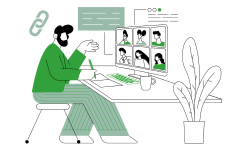
Design decisions are then shaped to support intuitive interaction and emotional comfort.
Lighting, spatial hierarchy, visual cues, and sensory elements are carefully developed to create environments that encourage exploration, collaboration, and focus.
04
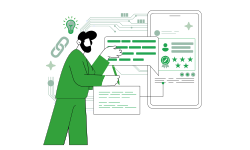
During execution, these behavioural considerations remain central to the process.
The final environment is realised with careful attention to how people move through, interact with, and emotionally respond to the space.

Related service


%401x.svg)
.png)
.png)
.png)


.svg)